9 Baffalos and more hippos die from Anthrax in Queen Elizabeth Park
An anthrax outbreak in Queen Elizabeth National Park has killed 82 hippos and nine buffaloes since June 2010.
The chairman of the National Anthrax Task Force Dr Nicholas Kauta told journalists on Thursday that the most affected areas are those surrounding Kazinga Channel and lakes Edward and George.
As a national response, he said, the task force is implementing a multi-pronged response which includes undertaking a base line study to determine the extent of the outbreak and affected species through carrying out carcass management, marine and terrestrial patrols and sample analysis.
He warned people around the area not to graze animals in the park, report all sicknesses and deaths in wild and domestic animals to authorities and not to consume meat from sick and dead animals.
He said there will be a ring vaccination of livestock in the national park and all health centres have been put on high alert.
Anthrax is caused by bacteria (bacillus anthracis) in the atmosphere. Animals mainly herbivores get it through contaminated grass, soil and water.
Humans can acquire it through eating contaminated meat and animal products from infected animals.
The park has often experienced attacks in 1954 and in 1994 and 2004. In 2004, about 300 hippos died.
The Uganda Wild Life Authority says there is no cause of alarm that all animals in the park might die because the beasts have natural immunity to the disease.
Compiled by
Jackie
Uganda Tour Operators urge Government to construct Roads
The Uganda Tour Operators have asked the Government to construct roads leading to major tourist destinations to ease the transportation of tourists.
The president of the Association of Uganda Tour Operators, Boniface Byamukama noted that bad roads had been a major hindrance in the transportation of tourists to national parks.
“When it rains, it’s almost impossible to take any tourist to these destinations,” said Byamukama who was speaking at the official opening of the association’s new offices in Kololo, last week.
Byamukama pointed out the Kagadi-Wima road, Kihihi-Kitunguru road in Kanungu district, Kabale-Kisoro-Bwindi road and Rukungiri-Bwindi road as the worst roads that hinder the Business.
Julius Onen, the permanent secretary at the tourism and trade ministry, urged tour firms to keep the dynamism to take tourism ahead.
He said construction of the roads would soon be done by the Uganda Wildlife Road Network Company.
Onen was also happy that the Tourism sector was slowly recovering from the effects of the recent Kampala bomb attacks that had got Tourists worried for their lives.
Compiled by
Jackie
Black back attack kills an Infant
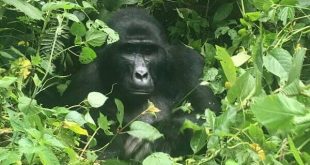
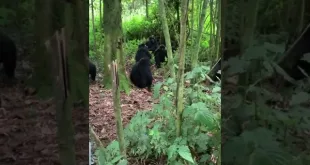
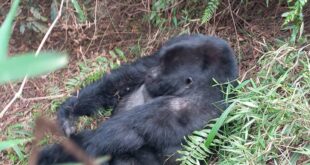
The absentee of the dominant silverback Isabukuru in a gorilla group, gave a chance to black back Kubaha to attack the group members in which a seven-month-old infant Agatako was killed, while his mother Bukima, who was carrying him. Kubaha was aggressive all morning towards all the females in his group.
“Most of the time, Kubaha displayed with chest beats and plant smashing and was tight-lipped and strut-standing towards group members. He was obviously nervous and uptight,” said Joel Glick, the Karisoke Research Center’s interim Gorilla Program coordinator, who was collecting data in Isabukuru’s group at the time.
It is unclear whether Kubaha, who is 11 years old and has not yet reached sexual maturity, was nervous about having to lead the females, or whether he was trying to attract their attention by showing off his strength, or both.
With tension mounting and females occasionally responding to his aggressions with gestures of appeasement or aggression, Kubaha launched a fierce attack against Bukima, who was behind a thick bush on the edge of the mountain. Her loud screams alerted the other females, who ran towards Kubaha. It was then, at noon, that Agatako, who was clinging to his mother, lost his life. However, the view was obscured for observers, so they could not establish beyond any doubt whether Kubaha directly targeted him, or whether he died in the interaction between the aggressor and his mother. Neither Bukima nor the other females sustained any injuries.
By the time Glick reached the group at the bottom of the mountain, just four minutes after Kubaha’s attack, Bukima was carrying her dead infant away from the other gorillas. His tiny body was covered in blood. When she finally laid him on the ground, every individual in the group approached him with curiosity. Bukima paced nervously, as though trying to decide whether to look for Isabukuru’s trail or watch over her dead infant.
This would not, however, be the end of the drama for the day. Kubaha next approached the dead body and started to display with it, as some of the females screamed.
“It was absolutely horrible,” said Glick, visibly shaken. “Kubaha flung the body in the air several times, let it drop to the ground, and then dragged it all over the place. He even chest-beat while holding the body in one hand. There was blood everywhere.”
This lasted for 15 minutes, after which Kubaha finally set down Agatako’s body. It was later recovered by the veterinarians, whose preliminary report indicated “deep puncture wounds,” most likely from canine teeth. This would indicate that Kubaha indeed bit Agatako.
A short while afterward, silverback Isabukuru returned to the gorilla group, unaware of what had happened in his absence. He had spent the morning some 600 meters away, trailing another gorilla group in the vicinity, according to the trackers who followed him. He stared in the direction he had come from and displayed three times, and then all was quiet, with no further aggressions.
Isabukuru himself was responsible for the only other case of presumed intra-group infanticide ever recorded when he was still a black back in Pablo’s group, in December 2006. Soon after he killed one Infant there, he left together with a few females and started the new group that is named after him.
Agatako was born on January 26. He was healthy, and Bukima was taking good care of him. He received his name - which means “ornament” in the local Kinyarwandan language - during the Kwita Izina ceremony last month. He was Bukima’s third offspring. Her previous infants all died as well.
Compiled by
Jackie
Uganda Tourism Vibrant Despite Bomb Blasts
The Uganda Tourists and tour operators earlier have been weary of the situation and its impact on the tourism sector. However, players in the field say apart from inquiries, there are no tourists canceling their booking and safaris that characterize the season will go as planned.
Hundreds of tourists book vocations in Uganda during this period to visit parks and especially to trek gorillas in Bwindi Impenetrable Forest. Concerns whether they would cancel their trips or change their itinerary have been quelled by further bookings, according the Mr Moses Mapesa, the executive director of Uganda Wildlife Authority, a body that is charged with keeping the national parks, among other tourism attractions
Assuring Tourists, Mr Mapesa said he has not received any cancellation, something that reassures the sector that the bombs scare will not seriously affect the business. On Wednesday morning, tour operators held a meeting at the Uganda Tourism Board offices in Kampala at the meeting, they resolved on safety measures of tourists in the country and those about to arrive.
Though the primary aim of the meeting the upcoming World Travel Market (WTM) fair in London due in November, tour operators addressed matters regarding the bombs scare because they could be damaging to their business.
Miss Najjuka, the manager of Katona tours and travel said that though some tourists who booked with her company are concerned and have been inquiring whether it is safe to visit the country, she is glad that none of them has cancelled and have sent 6 groups of Tourists to National parks this week. Three Tourists are hiking Rwenzori, One couple is on 21 days Vacation to celebrate their marriage , a group of 5 has gone for a grand safari and the rest of the groups are tracking gorillas.
Mr Baluku, a secretary general of the Association of Uganda Tour Operators (AUTO) said,, "No park has been far closed, so as long as visitors observe safety precautions, the situation is very normal."
Uganda Tourism Board's Edwin Muzahura added, "I have met the private sector in tourism and we have agreed on updating our clients on the situation back home." He said providing factual updates on the website, twitter and face book helps tourists understand the situation as it is, and not to scare them away.
"These scares happen anywhere and tourists cannot stop to come because two bombs are detonated in some parts of Kampala. For example, South Africa was on high alert before and during the World Cup, but millions of football fans watched the games peacefully. The situation in Kampala is very controllable and every other places tourists visit, are more security conscious than possibly they have been."
Mr Mapesa adds, "People out there understand that there are security concerns in America, Europe, Asia and everywhere." He said there are reasonable security measures in place to protect the tourists from harm, adding, UWA has enough security on its own in all national parks.
"The safaris are done in the total guidance of our staff. We tell our visitors to travel during the day and to be inside by 7p.m.," he says, adding, "And even when a tourist asked for a self guided tour, we advise them on routes and give them a map."
Mr Muzahura told Saturday Monitor, the situation is under control and that is why the government has not issued any travel advisories. Mr Baluku adds, the coming months are high season for safaris and if the government serves advisory notices, it would heavily impact on the tourism industry.
Compiled by
Jackie
Uganda to inject cash in Faith Tourism
The Uganda Tourism Industry is positioning itself to aggressively market its faith-based Tourism as it looks to diversify its products.
The initiative is backed by the increased arrivals for the annual Martyrs’ Day celebrations held at the Uganda Martyrs Shrines at Namugongo.
It is believed that around 997 Tanzanians came for the national Martyrs’ Day celebrations, over 200 from Kenya, while 32 came from Arizona, USA for the single-day event as disclosed by the state minister for tourism, Serapio Rukundo.
“There is a future for faith-based Tourism. Like we used to go to Rome, Israel and Mecca, I think people will be coming here more,” said Rukundo while briefing an Austrian investment firm, A-TEC Industries, recently.
Thirty-one Christian prisoners were burnt in the holocaust at Namugongo on June 3, 1886. Every year 3 June is honored as a public holiday in Uganda. It is also marked worldwide on the church calendar in honor of the Uganda Martyrs.
But what has made this an emerging hot tourism event on the annual calendar is that outside the main celebrations, the village of Namugongo, about 12 kilometers from Kampala city, explodes in a carnivore atmosphere.
Traders and transporters using the opportunity make a kill by selling all kinds of merchandise from souvenirs, refreshments and “simply celebrating life.”
It is this that Uganda Tourism Board (UTB), wants to act as a stepping stone since the martyrs trail was fast catching on in prominence and interest.
Meanwhile, A-TEC is looking at venturing into Uganda’s tourism sector, mining and energy markets.
Bernhard Rippel, A-TEC Industries director of corporate affairs says the firm will consider building a tourism school on the model of a public-private partnership.
Rippel said A-ITEC operates similar models in Oman and Kabul where the company funds the development of the curriculum, training and implementation, while the government pays tuition for the students.
He promised that the dean of the tourism school in Oman will visit Uganda at a yet unconfirmed date to explore on what basis a tourism school will be established.
Serapio outlined Uganda’s attractive tourism diversity of 10 national parks, 12 wildlife reserves and home to more than half of the surviving mountain gorillas, saying the sector still has room for new investments.
Compiled by
Jackie
Uganda Tourism news
Uganda Kampala still safe for Tourists
Ugandan officials are urging foreigners not to cancel their travel plans.
"Kampala is safe," said Cuthbert Baguma, executive director of the Uganda Tourism Board, in a statement.
Baguma said that security agencies are on "full alert" and the situation is under control.
"There is no need to cancel or change itineraries because there is no indication of a re-occurrence of any sort."
Uganda is emerging as an attractive ecotourism destination. Primate safaris, bird watching and village tours are popular activities in this East African nation.
Uganda has attracted an increasing number of tourists looking to get close to gorillas, chimpanzees and other wildlife. American and British travelers interviewed reported having positive experiences in Uganda and did not feel unsafe.
The Ugandan government is committed to the safety of foreign tourists, who are an important source of revenue.
"Bwindi national park and other popular tourist destinations are safe and remain open to tourists," said Tourism Board director Cuthnert Baguma after Sunday's attacks.
"The bombing was intended to scare and discourage visitors. Uganda Tourism Board reassures visitors that Uganda is safe and that the government is committed to maintaining Uganda as an attractive and secure tourist destination."
Secretary of State Hillary Clinton released a statement strongly condemning the attacks at Kampala's Ethiopian Village restaurant and Kyadondo Rugby Club.
"At this tragic moment, the United States stands with Uganda," said Clinton.
"We have a long-standing, close friendship with the people and Government of Uganda and will work with them to bring the perpetrators of this crime to justice."
Compiled by
Jackie
America gives Shs12b to Uganda Tourism
Uganda has announced plans to introduce “marine tourism” to its list of core sightseeing marvels after the US government offered $6 million (Shs12b) to support the thriving sector over the next five years.
Mr Muzahura Edwin, Uganda Tourism Board’s public relations officer, said that they intend to start with purpose-tailored marketing of tourism treasures on Lake Victoria - the world’s second largest freshwater body.
“We have rapid waterfalls and sites for water-rafting. That’s why we want to introduce marine tourism which the Americans suggested and are willing to support,” he said after a meeting on Thursday with US Ambassador Jerry Lanier.
The meeting was at Mweya Safari Lodge in Queen Elizabeth National Park to launch United States Agency for International Development’s Shs12 billion domestic tourism campaigns, the US Mission in Kampala announced.
The campaign will raise awareness among Ugandans about the importance of their nation’s natural heritage and the need to improve conservation efforts.
It will also encourage tour operators, hotel owners, and others in the tourism value chain to promote reasonably priced facilities to tourists in Uganda as a means to ensure long-term economic growth in Uganda’s tourism industry.
From the Tourism Industry, last year Uganda got $746m (Shs1.5 trillion) from 842, 000 tourists, most of them foreigners, and the sector is the fastest growing at 8 per cent this year.
The USAID programmer will focus on the Albertine region and promote conservation and increase shared profits with rural Ugandans who shoulder conservation costs, the embassy said. “Sharing these benefits is the best way to build a local constituency to support wildlife conservation, which is the tourism resource base for Uganda’s future generations.”
Compiled by
Jackie
Tourists and workers would need 1 visa for 5 East African countries
The Five East African nations want to collapse their borders so that foreigners will need only one visa to travel to any of the five nations.
The proposal is part of an effort to forge Uganda, Burundi, Kenya, Rwanda and Tanzania into a single market and increase investment in the region said the Kenya Immigration Minister Otieno Kajwang.
Negotiations are at an advanced stage, he added. The European Union's 25-nation zone of open frontiers is being used as a model, and negotiations will conclude soon.
Citizens of Burundi, Kenya, Rwanda, Tanzania and Uganda do not need visas to travel within their economic bloc, the East African Community, which on Thursday officially began operating as a single market with one set of regulations. Each country, however, still has to change a wide range of laws including labor, taxation and immigration to conform to the protocol.
On Friday, Kenya waived all work permit requirements for East Africans, who will only need to register with the immigration department as a formality, Kajwang said.
"We want to show by example that what we have agreed on we are implementing, and this will create a lot of goodwill," Kajwang said. He noted that Rwanda in late 2007 eliminated work permit requirements for all citizens of the community.
He cautioned, however, that there are still difficulties ahead in fully implementing the East African Community's Common Market Protocol, such as resistance from bureaucrats. It took five years to negotiate the protocol and at times talks stalled because of fears that individual countries would lose their sovereignty or that Kenya's better established businesses would dominate the region.
If all goes as planed, there will be easy movement of Tourists with in the East Africa Region, leading to the development of the Tourism Industry in the Region.
Compiled by
Jackie
Uganda’s Kabaka tips on Tourism
The Buganda King “Kabaka”, Ronald Muwenda Mutebi, has called on the Baganda tribe to promote tourism in the kingdom to boost economic development. Speaking at the Buganda tourism expo in Lubiri palace, Mengo last week, the Kabaka said Buganda is well situated, making it easily accessible by tourists.
He said the kingdom has many cultural and historical sites, which can attract Tourists.
“I call up on you all to identify cultural sites and recommend them to our tourism ministry, which will make arrangements to rehabilitate them and take development to our people in those areas.”
Mutebi thanked the exhibitors and sponsors of the event, including Centenary Bank and Uganda Breweries.
The function that was graced by thousands of people included an exhibition of snakes, birds, antelopes, monkeys, a lioness, tortoise and ostrich.
The Buganda premier, Eng. J.B. Walusimbi, said his cabinet had in the last two years lobbied for the return of kingdom property in the possession of the central Government.
He listed another challenge as ensuring that the kingdom radio, Central Broadcasting Station that was closed by the Government is re-opened.
Walusimbi urged the tourism ministry to enlarge the museum to include past kings like Ssekabaka Kintu, and all the 35 kings.
On the restoration of Kasubi tombs that were gutted by fire in March, he said it was an enormous task that still requires sh10b.
Walusimbi added that the Kabaka’s 17th coronation anniversary will be held in Butambala on July 31.
“These functions strengthen the king because the challenges are many. I have requested religious leaders to arrange prayers all over the country on that day,” Walusimbi added.
Compiled by
Jackie
Tourists at Lubiri get excited by a Lioness
Ugandans have been urged to conserve the environment and protect wild life because they are a source of income through tourism.
In his speech, Dr.Seguya Andrew, the executive director of Uganda Wildlife Education Centre said Uganda has a comparative advantage over the rest of the world. Uganda has more animals and plants species compared to Europe and Asia.
Dr Seguya who was speaking at the ongoing cultural exhibition at Lubiri in Mengo said Uganda has a big tourism potential. “This is why we should keep this sector jealously to stop people from killing wild animals and encroaching on wetlands and forests,” he added.
The major attraction of the center’s stall at Lubiri was a lioness. Other animals that were exhibited include pythons, an ostrich, the red-tailed monkey and the African fish eagle, among others.
Compiled by
Jackie